Tuesday, July 15, 2014
Monday, June 23, 2014
SPARK XTR Adjustable LED Light Source
Medit Inc. is pleased to introduce a new LED Borescope Light Source SPARK XTR that we added to our product range.

The Spark LED flash light was specially designed to improve working conditions and provide customers with a cost effective solution. The LED chip is combined with a specialized focal lens to produce higher light intensity. The device also boasts with adjustable strobe lights and easy light output control. The body is made out of high grade aluminum which prevents the light source from heating up even after a long period of use.
The device is very compact in size and weighs only 105g. It is powered by a rechargeable 2,000 Ah, 3.6 V Li-ion battery with up to 50 minutes of operation at full intensity .
The light source is compatible with a wide range of leading borescope brands, including Olympus.
This tool is a "must have" for routine remote visual inspections.
Monday, June 9, 2014
Waterproof STRAHL Pole Mounted Inspection Camera is now available
 |
The Inspection Camera has 8 High-output LED Light and a flex-and-Stay Camera Neck. The pole itself extends from 0.95m to 2.2m which gives you a total length of 3.3 meters. The camera operates on a high-capacity rechargeable lithium battery offering up to 6 hours of uninterrupted operation. With a 180 degree rotation display its allowing to view images from all different angles. Inspection process can be captured on Micro SD Card up to 16 Gb capacity.
This Pole Mounted Inspection Camera is a great device for military, law enforcement and very handy to use on criminal investigation. It is very convenient to use on and behind walls, bridges, roof, ceiling and other structures located near or in water and also for under vehicle.The Waterproof STRAHL camera is a good and affordable addition to our line of pole mounted inspection systems.
Tuesday, December 3, 2013
What is a good and affordable sewer camera?
Can affordable sewer cameras also be good, delivering
high quality images, navigating different types of pipes with ease, portable
and offering multiple features for documenting, viewing and organizing
inspection findings?
 Yes, it can. The time when sewer cameras were expensive,
bulky machines is long gone. Modern designers and manufacturers are closely
following the needs and demands of Remote Visual Inspections industry, trying
to create versatile, highly mobile and efficient viewing devices that would not
only deliver exceptional inspection footages, make the work of inspectors much
safer, easier and more productive, but would also be inexpensive cutting down
overall inspections costs. What can be more important than gaining profit and
gaining more clients at the same time?
Yes, it can. The time when sewer cameras were expensive,
bulky machines is long gone. Modern designers and manufacturers are closely
following the needs and demands of Remote Visual Inspections industry, trying
to create versatile, highly mobile and efficient viewing devices that would not
only deliver exceptional inspection footages, make the work of inspectors much
safer, easier and more productive, but would also be inexpensive cutting down
overall inspections costs. What can be more important than gaining profit and
gaining more clients at the same time?

CAIMAN Sewer Camera is one of those innovative devices
offering a whole scope of advanced characteristics at an affordable price.
The Camera is equipped with a high-resolution CCD
self-leveling camera and 18 high-output LED lights integrated at the tip of a
flexible fiberglass probe that can navigate pipes up to 120 meter long and can
be easily traced underground due to built-in 512 Hz sonde. The self-leveling
feature ensures that the camera keeps the upright position inside the pipe at
all times, which is important if the probe has to travel long distance or pass
multiple bends. The camera head is protected by an anti-scratch Sapphire lens,
which guarantees high quality picture for a long time even if you have to use
the camera in harsh or scratchy environments. Both, the probe and the camera
head, are tightly sealed and are 1 Bar water-proof, allowing for different
types of sewer and drain inspections with submersion.
CAIMAN’s control unit is conveniently mounted on a light,
compact wheeled reel that can house up to 120 meters of insertion probe. The
control unit features a 7” digital monitor with 720 X 560 resolution. Snapshots (JPEG), video (AVI) and audio (MPEG4)
recordings of the inspection can be replayed right on site, sent to a computer
through a USB cable or saved to a micro SD card.
Additional features include length counter, informing an
operator of how much probe has been inserted, IR remote control, rechargeable
Li-ion battery, 13.5V battery backup station with 10 hours working capacity.
CAIMAN offers users exceptional sewer inspection experience
at no extra cost or effort.
Thursday, October 10, 2013
What is a good bore scope for day-to-day remote visual inspections?
Whether you are a hired professional operating on the
company’s budget, self-employed businessman trying to be smart about the money you
invest in your company’s development or just a responsible home-owner searching
for a particular bore scope, it’s always important to ask yourself several
questions before purchasing a piece of equipment for remote visual inspections –
How versatile is it? Will I be able to use it for different applications or
just one type of inspections? Am I planning to use it on the regular basis once
the project, requiring the use of this particular tool, is over?
 One of the latest versatile imaging devices that has been
tremendously popular among our clients lately is a small, compact, hand-held JT-AlphaVideo Borescope. This starts to make sense as you look closely at the scope of
features it provides.
One of the latest versatile imaging devices that has been
tremendously popular among our clients lately is a small, compact, hand-held JT-AlphaVideo Borescope. This starts to make sense as you look closely at the scope of
features it provides.
First of all, it is the highly intuitive single-handed
operation it offers due to ergonomic, non-slip design and a joystick control and
buttons conveniently located right under your fingertips. You can easily
navigate the probe even through the tightest spaces, corners or bends as the
probe’s short distal end articulates in four directions by means of the joystick
control, and capture images by a single push of a button. And do all that with just
one hand, which becomes especially handy if you have to work standing on a
ladder or carry out inspections in extremely confined spaces.
Secondly, the four-way tip articulation does not only make
the probe extremely maneuverable and pushable, it contributes to high quality,
detailed inspection images. Take into account super intense LED lights
illumination and a high-resolution (800x600) CMOS image sensor, and you receive
a compact, highly maneuverable imaging device with exceptional viewing
capabilities.
The scope also features a durable, flexible stainless steel
braided insertion probe (available in different lengths and diameters), 3.5”
TFT LCD display and a USB slot to transfer images to a SD card.
With all of that said, JT-Alfa definitely stands out from
other videoscopes of its class as a highly portable, versatile viewing device
that will greatly enhance your productivity and save you a great deal of money
in the long run.
Thursday, July 4, 2013
New LED Light Source for Olympus
Today LED lamps or bulbs gain more popularity, with decreasing costs and increasing power. LED lamp is a solid-state lamp that uses light-emitting diodes (LEDs) as the source of light. LED lamps offer long service life. LEDs are often used in endoscopy because they provide white light, high efficience, portability and small power consumption. The lifespan of LED is longer than that of HID, xenon or halogen bulbs and last more than 80,000 hours.
Many endoscopes utilize LED light source designed as handles. Due to various design of light post it is necessary to have adapters for every endoscope. If it is required to obtain a new LED light source, it is important to find LED light source with correct light post adapter.
Olympus endoscopes are very popular worldwide, and a new LED light source is suggested for Olympus endoscopes, gastroscopes and fiberscopes.
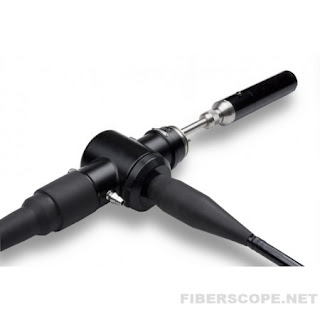
SPARK-OL LED light source is a portable light handle specifically designed for Olympus endoscopes. It provides powerful illumination. SPARK-OL light source combines latest LED chip and special focal lens, and it produces up to 10% more light intensity than the most powerful light sources in its class.
Its body is composed of high-grade aluminum with an anodized finish.
Spark-OL LED light source for Olympus borescopes can be quickly attached to an endoscope by means of a rotating adaptor without having to rotate the whole handle, offering great convenience and freedom of portability.
You can find more LED light sources here
Many endoscopes utilize LED light source designed as handles. Due to various design of light post it is necessary to have adapters for every endoscope. If it is required to obtain a new LED light source, it is important to find LED light source with correct light post adapter.
Olympus endoscopes are very popular worldwide, and a new LED light source is suggested for Olympus endoscopes, gastroscopes and fiberscopes.

SPARK-OL LED light source is a portable light handle specifically designed for Olympus endoscopes. It provides powerful illumination. SPARK-OL light source combines latest LED chip and special focal lens, and it produces up to 10% more light intensity than the most powerful light sources in its class.
Its body is composed of high-grade aluminum with an anodized finish.
Spark-OL LED light source for Olympus borescopes can be quickly attached to an endoscope by means of a rotating adaptor without having to rotate the whole handle, offering great convenience and freedom of portability.
You can find more LED light sources here
Monday, July 1, 2013
Door to MicroWorld Opened by Digital Microscope

Microscopic observations are often required during inspection of structural defects, welding, imperfections in electrical components.
Detalizator Portable Microscope can be used for such applications. Imaging power of Detalizator is great inspete of very small size. The Microscope features high image quality, zoom, snapshot functions, recording options. Detalizator Portable Microscope also offers a great variety of lighting techniques,
Detalizator Portable Microscope can be used for such applications. Imaging power of Detalizator is great inspete of very small size. The Microscope features high image quality, zoom, snapshot functions, recording options. Detalizator Portable Microscope also offers a great variety of lighting techniques,

including bright and dark field, transmitted, polarized, and differential interference observation, and provides ample magnification range (0.3x-200x). This device also supports reflected lens tube allowing users to capture positive images when a mirror is attached.
Detalizator Portable Microscope can be attached directly to PC or laptop by means of Orion USB handle. It can be also used with Orion Base monitor with 3.5'' display with JPEG and MPEG4 files capturing options and ED-CAM – imaging and recording hub with 7'' digital display.
Please see more compatible systems here.
Friday, June 14, 2013
Finding the Best Inspection Camera
While inspecting engines or other equipment there are a wide variety of situations when you might find it necessary to rely on a good inspection camera. Such inspection cameras can couple with different insertion probes, which are convenient in different cases. Finding the best probe for the specific task can be complicating and expensive.
For example, a flexible probe allows observing hidden places which cannot be seen directly. Articulated flexible videoscope can shoot a good video inside closed boxes or hollows. Long flexible probes are significant for inspection of tubes or pipes. But sometimes rigid borescopes are more convenient, because they give a better image at a lower cost compared to a flexible fiberscopes. The image is exceptionally clear. When an object is located within direct access, rigid borescopes are the best. However disadvantages of rigid borescopes include their fragility.
Different tasks require a number of inspection tools: flexible borescopes with various length and diameter, rigid borescopes, video cameras and light sources. Purchasing them separately can be costly and unprofitable. A universal system would be the best way out.
The new inspection camera system ED-Cam from MEDIT is a universal, portable inspection device, which can be coupled with a lot of rigid and flexible probes. Simply change the videoprobes for your specific task.
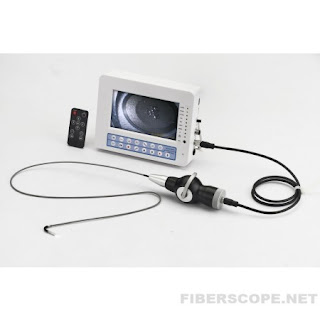 This inspection system includes a portable recording hub with a high-resolution color 7" LCD display and a CCD camera with 1.3 Mp resolution. The universal focusable video coupler can be attached to any 32 mm optical (either rigid or flexible) borescope eyepiece. Included IR remote control offers inspection operability.
The unit can record still images and video with voice recording to SD memory card or to laptop via USB cable. The display allows to observe every detail.

It is possible to locate the ED-Cam Inspection Camera System to any inspection site even without electricity supply, it can be powered from both rechargeable battery up to 4 hours, or an external power supply. You can see some variants of installation in the pictures.
More details about MEDIT inspection cameras can be found here.
For example, a flexible probe allows observing hidden places which cannot be seen directly. Articulated flexible videoscope can shoot a good video inside closed boxes or hollows. Long flexible probes are significant for inspection of tubes or pipes. But sometimes rigid borescopes are more convenient, because they give a better image at a lower cost compared to a flexible fiberscopes. The image is exceptionally clear. When an object is located within direct access, rigid borescopes are the best. However disadvantages of rigid borescopes include their fragility.
Different tasks require a number of inspection tools: flexible borescopes with various length and diameter, rigid borescopes, video cameras and light sources. Purchasing them separately can be costly and unprofitable. A universal system would be the best way out.
The new inspection camera system ED-Cam from MEDIT is a universal, portable inspection device, which can be coupled with a lot of rigid and flexible probes. Simply change the videoprobes for your specific task.


 This inspection system includes a portable recording hub with a high-resolution color 7" LCD display and a CCD camera with 1.3 Mp resolution. The universal focusable video coupler can be attached to any 32 mm optical (either rigid or flexible) borescope eyepiece. Included IR remote control offers inspection operability.
The unit can record still images and video with voice recording to SD memory card or to laptop via USB cable. The display allows to observe every detail.

It is possible to locate the ED-Cam Inspection Camera System to any inspection site even without electricity supply, it can be powered from both rechargeable battery up to 4 hours, or an external power supply. You can see some variants of installation in the pictures.
More details about MEDIT inspection cameras can be found here.
Friday, June 7, 2013
What is a Sewer Camera Inspection
Because sewer lines are located underground, the problems with them are often hard to detect until they come in the open, as let’s say a sewage back-up.
Sewer lines may be flat, offset, root-infested, or even broken, which can end-up in reoccurring sewer clogs or back-ups, leading to property damage, loss of operating time for businesses and costly repairs. However, sewer camera inspection can spare you from this nerve-racking experience. This new non-destructive testing (NDT) approach allows both contractors and their clients to save time and money on excavation jobs while getting a full picture of the problem area.
 |
| Inspection with Sewer Camera |
There are several ways to inspect a
pipeline remotely depending on the nature of the problem. NDT specialists can
run a snake in the pipeline through a manhole in the street, or check the
condition of your pipes right in your bathroom or kitchen.
Usually sewer cameras consist of an
insertion probe with a camera integrated into its tip. There are different
lengths and diameters of probes, and various types of cameras for specific applications.
You can watch the whole process on the display.
Sewer camera inspections are also important
as a preventative measure, before pipeline relining, or when cleaning a pool.
They can not only detect clogs in the pipelines, but inform you of the condition
of the pipeline and what kind of material was used to construct it, thus
allowing you to make an educated decision on future repairs and plan the
budget.
Benefits of sewer camera inspections:
- No need to pay over and over again to repair reoccurring sewer problems
- No unnecessary tearing apart the whole area or digging
- No guesswork
- No paying for repairs that aren’t your responsibility
You can find a wide selection of sewer cameras by following this link
Monday, June 3, 2013
Tips for Best Mainline and Infrastructure Inspection
 It is vitaly important to examine sanitary infrastructure before buying a property or making investments, and before building new estate objects.
Sewer pipe problems have indicators, which can be revealed during video inspection of pipe system. Some of the most noticeable signs are:

- Water stains - sign that the sewer line is not draining properly.
- Physical damages - cracked walls or floors suggest movement of the foundation.
- Outside “cleanouts” - outside cleanout that is not original to the home is a possible sign that repair was performed recently.
- Trees - near the area of the yard where the sewer line runs should always be cause for concern, because their routes can break old pipelines.
- Hidden damages of pipeline - can be detected only during video inspection with the help of special cameras.
 A new CYCLOPS Manhole Inspection Camera can be used for inspection in sewer, water, and waste mainlines,
ducts and pipes. This unit has a telescopic rod for easy single-user operation and ideal for pipes with diameter from 200 mm (8’’) to 2.000 mm (78’’). This Inspection camera is equipped with a new generation of LED lights that automatically illuminate the inspection area at zoom in. CYCLOPS manhole camera has a powerful zoom (36×optical and 12×digital) with a detection distance up to 80 meters. The camera body tilts automatically up 45° and down 90°. Inspections can be recorded by either image (MPEG) or video (MPEG4/AVI) capture and saved onto a 4Gb SD memory card. The imaging hub is equipped with a 5.7’’ TFT color monitor with 640x480 pixel resolution.
A new CYCLOPS Manhole Inspection Camera can be used for inspection in sewer, water, and waste mainlines,
ducts and pipes. This unit has a telescopic rod for easy single-user operation and ideal for pipes with diameter from 200 mm (8’’) to 2.000 mm (78’’). This Inspection camera is equipped with a new generation of LED lights that automatically illuminate the inspection area at zoom in. CYCLOPS manhole camera has a powerful zoom (36×optical and 12×digital) with a detection distance up to 80 meters. The camera body tilts automatically up 45° and down 90°. Inspections can be recorded by either image (MPEG) or video (MPEG4/AVI) capture and saved onto a 4Gb SD memory card. The imaging hub is equipped with a 5.7’’ TFT color monitor with 640x480 pixel resolution.
You can learn more about these inspection cameras here
Thursday, May 30, 2013
Videoscope for Gas Cylinder Inspection
 There are many industrial areas which require careful inspection. Gas Safety Regulations demand regular inspection of gas cylinders for defects. Many techniques are used to achieve this. Often visual inspection by borescope or video borescope is applied. The insertion probe of videoscope is inserted into empty cylinder and the operator can observe the inner surface.
A new videoscope is offered to perform such inspections. JT Alpha bore scope offers 4-way articulation and easy navigation and control by joystick. High resolution screen depicts nice image. Steel braiding protects the probe from scratches. Powerful LED light source provides a good illumination. JT Alpha video bore scope is an efficient tool that makes the work of video inspections cost-effective,
comfortable, fast and highly productive.
You can see more information about this class bore scopes following this link
Wednesday, May 8, 2013
Why are rigid borescopes better?
Some specialists are
interested in rigid borescopes and they want to know their pros and cons.

The
illumination can be provided either by LED light source attached as a handle to
the light post of the borescope, or by external powerful Metal Halide, Xenon or
Halogen light source. In this case the light is transferred via flexible glass
fiber guide. An internal
image of the object is formed by the objective lens and magnified by the
eyepiece, which presents it to the eye.
What are advantages
of rigid borescopes? They provide a superior image at a lower cost
compared to a flexible fiberscopes. The
image is exceptionally clear. When an object is located within direct access,
rigid borescopes work well. They are recommended for gunsmithing, automobile
inspection like observation of automotive cylinders, injectors and hydraulic bodies.
It is possible to attach a video camera to the eyepiece, and after that the
inspector can record video and still images for further processing.
What then are
disadvantages of rigid borescopes? Rigid borescopes are limited to access to a
straight line. It is impossible to view hidden objects behind something. Besides they are fragile instruments and don’t
like falling down.
There are many rigid borescopes in the market
with diameter from 1.8 mm to 8 mm and length from 10 cm to 90 cm. As you can see they have more advantages than
disadvantages and can be very efficient for inspection workTuesday, May 7, 2013
Unboxing Sewer Camera Viper-S
Watch the sewer pipe inspection camera Viper-S out of the box. Here is the source of the similar to VIPER-S affordable sewer push cameras.
Sunday, April 28, 2013
Borescope and iPhone

To see a new borescope that can be used with IPhone, IPad or Android devices - please visit this page.
Friday, April 19, 2013
Introduction to Orion-USB borescope inspection camera
A new USB video borescope opens new frontiers in borescope inspection. With this borescope USB handle it is possible to connect a wide variety of probes to any laptop, desktop or tablet and make it a perfect tool for inspection. Many probes are available: rigid, rigid with articulation, flexible and flexible with articulation and length from 1 meter to 30 meters. Please watch the following video introducing this outstanding videoscope. You can find more information here.
Friday, April 5, 2013
How to Use an Inspection Camera?
Today borescope testing gains more and more popularity. But some
technicians doubt if they have enough skills to work with an inspection camera. However
working with it does not require special knowledge or
skills. There are some simple rules to follow.
 |
First of all it is necessary to determine the correct length and
diameter of insertion probe. Then you have to think about what is better to use
– rigid or flexible probe. If you need to document your inspection, you would
need an inspection camera, which has a special monitor hub with
recording ability.
With the help of an optical borescope you will perform a visual
inspection through a device eyepiece. Insert the probe with caution through
the inlet and switch on the light source. You will immediately see the desired
area. In case of an inspection camera turn the power on to activate the device and the
light source, and insert the probe. If light intensity is too strong, you can
gradually decrease it. Press on recording button and your video will be
recorded in AVI or other format onto an SD card.
Remember that borescope probes are rather fragile; therefore it is
better to avoid excessive bending or forcing.
Here is an example of using an inspection camera to
inspect a car engine. When a
car has an interference engine, if the timing belt failed, it is quite possible
that the pistons hit valves before the engine stopped completely. After a compression
test, if the valves are bent they will not seal properly, and the compression
readings will be low. Then you can take a scope and inspect through the
spark plug holes and look for impressions on the piston tops. Inspection cameras with 2
meter long probes and tip articulation are the most convenient for this kind of
inspection. The flexible probe will show the damage that may
have occurred without disassembling the top part of the engine. To learn more about one of the most popular MEDIT's inspection cameras - VOYAGER, please, go here
Wednesday, March 27, 2013
Videoscope is Working in Water
See video demonstration of videoscope Rigel in water. Videoscope Rigel has water-prrof insertion probe with diameter 5.5 mm and articulation of tip. It is perfect for automotive, aviation, plumbing and other areas.
More details here
More details here
Thursday, March 21, 2013
Videoscope vs. Fiberscope. What is better?

Today there is a great variety of borescopes. Inspectors can choose between an optical or a video
tool. But what advantages do videoscopes have? Why are they becoming more and
more popular? Video observation is preferred over optical
inspection because video recording allows the inspector to see wider area at a
greater distance or take advantage of the zoom capability as opposed to a
limited, darker traditional flexible borescope optical image. They
also help the specialist to avoid eye strain and test fatigue because they
offer a more comfortable and natural work environment in front of a display engaging
both eyes. In addition, the resolution is much higher and there are no moiré
interference, mosaic dots of flexible image fiber bundle.
Videoscopes allow
inspectors to record observation results. It is especially convenient when a
subsequent review of findings is necessary. Modern computer processing enhances
detail, and performs an online image
analysis. Videoscope image is generated by CCD sensors and
then transmitted via electrical wiring to recording and imaging hub. Generally
light source is integrated with the camera at the probe tip. In most cases a
light source consists of one or more LED bulbs. Heavy-duty professional and
expensive models of videoscopes offer Metal Halide or Xenon light source built
into the imaging hub. Such light sources have higher light intensity but more power
consuming.Often inspectors are looking for a higher pixel
resolution of CCD chip. However don't rely on pixel count only when evaluating
performance: it is necessary to test CCD performance in each individual case
using a resolution target.
Videoscopes are more energy-depending devices
than optical fiberscopes, and this can sometimes be an
obstacle. Optical fiberscopes generally don’t need powerful energy cells.
Energy is provided only for light source and often it is a small LED light
source-handle attached to the body of a fiberscope. Video inspection devices are not as fragile as optical ones consisting of glass fiber bundle. Metal braiding helps to protect
wiring and camera from damage.
As you can see, videoscopes today are better
choice for inspectors, technicians and other specialists in many industrial
spheres.
To learn more about videoscopes click here, to see some fiberscopes and their specifications go here.
To learn more about videoscopes click here, to see some fiberscopes and their specifications go here.
Friday, March 8, 2013
What is a Borescope?
A borescope is an
inspection device with a rigid or flexible optical tube to insert into bores,
pipes, holes and cavities for visual inspection.
Borescopes are used in a wide range of industrial control and inspection applications. It consists of an objective lens in front of a long glass optic tube containing an image relay and an illumination relay. The relay tube can be rigid or flexible and is followed by a handpiece containing an eyepiece.
Borescopes are used in a wide range of industrial control and inspection applications. It consists of an objective lens in front of a long glass optic tube containing an image relay and an illumination relay. The relay tube can be rigid or flexible and is followed by a handpiece containing an eyepiece.
Important
specifications for borescopes include rigid or flexible image relay, working
length, field of view (FOV), direction of view (DOV) and minimal focus
distance. The image relay diameter is the diameter of probe for insertion into
cavity. This diameter typically determines the minimum size hole the scope can
be used within. The working length is the length of the probe. The field of view is the viewing cone
included in the viewing angle. It is a
measure of how much of the visual field is taken up by the image. The direction
of view is the direction the axis of the viewing cone points, where zero
degrees is straight ahead and 90 degrees is looking to the side. The minimal
focus distance for the borescope is the minimum effective focusing distance.
Flexible borescopes
tips may be bent back and forth using a control in the handpiece, which allows
changes to view angle or navigation through paths that are not straight. A two way articulated tip can be manipulated
or "curled back". Two-way
implies single plane of articulation, as in only right-left or up-down. A four way articulated tip can be manipulated
or "curled back" in two plane articulation, as in both right-left and
up-down. Specifications for articulation
range give the maximum angular articulation possible, measured from 0° as
straight-ahead. It is important to know minimal bending radius. Repeated
bending of a flexible borescope below the minimum bend radius will result in
broken image and/or illumination fibers.
Looking for quality, yet affordable borescope? Shop here.
Thursday, February 21, 2013
Comparison of Rigid vs. Flexible Videoscopes
What is the difference between rigid and fully flexible articulated videoscopes? Where is it better to use rigid probe and where - flexible? These and some other questions are answered in the following video. This video is about rigid videoscope Heron and flexible videoscope Rigel. You can see details here.
Subscribe to:
Posts (Atom)