Wednesday, April 4, 2012

How to Keep Chimney Clean

      We all love the view and atmosphere of relaxing ambiance and comfort created by fireplaces. But fireplaces and chimneys require control and care. Not only houses, but also industrial chimneys are to be inspected regularly for safety and efficiency.
Chimney Inspection Cameras are becoming increasingly popular, especially when physical inspection of chimney surfaces is not feasible. This is particularly necessary for small diameter chimney liners, old stone flues in unknown condition, in order to get safety certificates.  

CCTV cameras are successfully used for a number of applications including:
  • Checking the condition of chimney and flues liners
  • Chimney survey and documentation
  • Confirmation of suspected crack or other potential flaws in the components
  • Visual inspection of chimneys prior to lining
  • Checking for damages after chimney fire or any sudden disaster that could damage the chimney.
  • Video documentation for insurance claims
  • Inspections of any blockages
The “Anaconda - CH" Pan-and-Tilt Chimney Camera is one of the most advanced devices to use for inspecting chimneys, air ducts, flue liners, fireplaces, and flues.   The best feature of this unit is the ability to pan the camera head 360⁰ and tilt it 180⁰ to view and capture every detail of your inspection. This allows technicians to get a full view and assess the condition of the liner and joints for any imperfections.  
 
The camera head features a compact (53mm) detachable design which is completely water and dust proof and contains 14 super bright LED lights to illuminate the walls and provide consistent illumination. The light intensity is easily controlled to avoid flaring, and the sensitive Sony CCD chip is protected by a thick scratch-proof glass lens, which can be easily cleaned with a lens spray or washed off.
Please contact me for more information, or go to chimney camera page on Fiberscope.net

Thursday, March 29, 2012

Think Green Or How Push Camera Can Help Ecology

 In many areas of the world people use geothermal sources or energy. Such geothermal sources are especially popular in Iceland, where such sources are abandant. But in many other parts of the world people use this cheap energy for heating or cooling. I found this extract in one of blogs: 
"When some people think of geothermal they think of harnessing the power of volcanoes, drilling holes in the Earth's crust and pouring water in to create a steam vent to turn a generator. Technically such things are possible, but they're also largely unnecessary. A lot of heat can actually be derived just by drilling down a little and using nothing more than air circulation to get heat; Hence the marvel of geothermal heating systems, a growing trend amongst home-owners.
Geothermal heating systems (also known as ground source heat pumps, GSHPs, earth energy, or geoexchange systems) are an ideal way of reducing home energy costs. These systems are incredibly environmentally friendly as it uses the natural heat of the Earth with no emissions or toxicity involved.
A series of pipes are drilled down into the ground to create a circuit. Air is then pumped through the circuit using a small electric fan (so there is technically a small amount of energy used to make the system work). The circulating air goes down into the ground cool and comes up warm. This is a similar concept to building your home in a deep cave, where the air temperature is constant all year long, but without the obvious problems of living inside a cave (taken from here)" 
Pan-and-tilt push camera AnacondaAnd push camera with video camera and powerful light source can help a lot in inspection of geothermal pipes. Many companies use push cameras for inspection of pipes from 8" to 30" and length up to 120 meters. 
Push camera Anaconda with a special convenient pan-and-tilt camera can perfectly match this task. Its camera can move in two directions and observe every bit of the pipe all around! This unique technology is combined with advanced light source. 
Please contact me for more information. 

Tuesday, March 20, 2012

Video Borescope for PT6 turbine inspection

I found a nice video of maintenance inspection of Pratt and Whitney PT6 engine using videoscope. Scope is inserted through the Kell-Strom guide tube part number PWC34910-200 for remote visual inspection of all internal parts. You can find more information about this videoscope following this link. You can also contact me for more information  konstantin  @  meditinc.com

Thursday, March 1, 2012

Rigid vs. Flexible Video Borescopes. How to make right choice?.


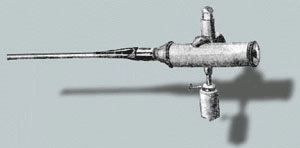
Video Borescopes are getting more and more popular.  They replace optical rigid and flexible borescopes, which stem from the first endoscope in 1853. 


 Video borescopes (or videoscopes) have many advantages. Videoscopes are not so fragile and have a higher resolution than flexible optical borescopes, which is a very important issue at remote visual inspection.  Contrary to optical borescopes, videoscopes possess recording feature, and additional bulky gadgets for inspection recording are unnecessary. 

Rigid Video Borescope HERON 
Rigid video borescopes can be readily used for non-destructive testing instead of optical rigid borescopes. Such non-destructive testing generally includes vertical or lateral inspections (turbines of planes, cylinders in car engines, barrels) through confined access in confined areas. Metallic insertion probes of rigid videoscopes reduce damages of the system during inspection.  


Flexible Videoscope QUASAR
Flexible videoscopes seem very attractive in areas, which require more freedom during remote inspection, e.g. bypassing corners or bends. There are video borescopes with both polyurethane, and stronger, stainless steel braiding, and even the strongest braiding – tungsten. Recently videoscopes with non-conductive braiding appeared in the market (IRIS), which meet modern industrial demands and are used in hazardous areas, where static electricity should be excluded. 

Rigid Videoscope with tip articulation 
New rigid video borescopes, combine advantages of rigid and flexible borescopes. Heron-A videoscopes have articulated tip and support diverse remote visual inspections.  Though rigid video borescopes still have some limitations, and main one is their limited length (generally no more than 70 cm) contrary to flexible videoscopes with length up to 30 meters.  


One of the most famous and reliable online sources, Fiberscope.Net, offers a great variety of video borescopes of economic, standard and premium lines with various design and technical features. Please contact technical consultants for more detailed information

Thursday, February 23, 2012

Application of videoscope in aircraft inspection


Videoscope QUASAR for inspection
In many industries and by many professionals, scopes have been used as widespread instruments. In the medical profession, for instance, an endoscope is used to access internal areas that are hard to reach. 
Similar equipment is used for aircraft inspection. Inspectors use videoscope, a kind of borescope, for this. It boasts of its monitor unit and flexible probe. This probe has its own camera with light source of tip, while LEDs are placed around the camera for easier conduct of inspection.
Quasar videoscope can be used as rigid inspection instruments that have the ability to go around almost every limit. The images provided often come in high quality. For an aircraft inspection, it is best to use the Quasar videoscope that offers a flexible kind of borescope ideal for industrial inspections. 
The Quasar videoscope is preferred for aircraft inspection since it provides topnotch resolution. This is also known for its ease of use.
Quasar videoscope can be easily manipulated because of its flexible tube allowing the viewer to see more distant areas. It also has a high-performance lithium ion battery that can last for up to six hours of operation. Users may also use support straps to ensure better mobility—depending on the actual model being used.
Through videoscopes, aircraft inspectors can identify and fix problems in a very short period of time. The Quasar 2-way videoscope, for instance, is best for industrial environments. This model has a stainless steel braided jacket as well as a two-way tip articulation. It can be controlled easily through a dial on the monitor, making it useful for engine and PT6 turbine inspections and repairs.
Technology has made things a lot easier, including the process of inspecting aircraft. One needs to know how to use it properly and how to get the value of their money’s worth. Videoscopes are also a way to ensure the safety of the entire aircraft benefitting those who use it for work.
To see this and other QUASAR systems, please go here.

Tuesday, December 6, 2011

New LED light source for borescopes


LED Borescope Light Source SPARK
I would like to tell you about interesting LED light source. This light source is specially designed for optical borescopes for growing demands in the NDT industry. 
It utilizes a newly designed LED chip which is combined with a specialized focal lens to produce 15% more light intensity then the most powerful light sources in the class. The body is composed of high grade aluminum with an anodized finish.
What I like most of all is that this light source is very bright and uses 3 standard AAA batteries, which can easily be purchased everywhere. We made a small experiment and tried to find the moment when this light source stopped working from batteries. Four hours passed, but this light source still gave a bright light beam!
I think this light source is a must-have for routine remote visual inspections.
To read more about and shop this borescope light source go here.

Wednesday, October 26, 2011

Unique Trogloprobe Pipe Inspection System


Pipe inspection Camera 
Now you can review Trogloprobe Heavy Duty Inspection System – unique pipe inspection system, which comprises the best features from all inspection systems ever produced. It is ultimate in ruggedness, reliability and ease of use. The simple, appearance includes such features as integrated video recording, full function text input with a metered display, six-hour lightweight battery pack and a mainline ready controller. The Trogloprobe Inspection System may include optional Wireless Viewing system – advanced and convenient viewer for ease of use.
With T710 camera the Trogloprobe is the only system in the market with 1’’ camera with such features. It is worth mentioning that the camera is IP68 sealed and can withstand up to 11 Bar pressure.
You can find more professional devices for pipe inspection here

Wednesday, October 19, 2011

USB Video Borescope handle


USB Borescope with articulating probe
This time I would like to tell about one interesting device. 
No secret that often it is more convenient to use a laptop for inspection – you can easily record video and see the place of inspection in a large screen. The new USB Video Borescope handle by MEDIT gives you such opportunities.  This lightweight and portable inspection device combines ease of use with innovative file capture technology. This hand piece connects directly to your computer or laptop through a single USB Cable (USB 1.1/2.0 format), displaying a live color image directly in a viewing program, allowing you to perform live inspections and capture images and video directly to your hard drive.

USB Videoscope by Medit
One more interesting detail – you can change probes according to your needs. A wide range of probes are available: flexible with diameter from 4 to 10 mm and length to 30 meters, 2-way articulated and even rigid.  
All of the probes that couple with this handle are water, diesel, gasoline, brake fluid, antifreeze, and oil proof. 
Well suited to Aircraft, Marine, Locksmith, and Automotive Inspections.

Thursday, September 29, 2011

Inspection of pipe

Today I found a short video of inspection by this push camera. What I liked in this camera - you can pan and tilt the image, which is very convenient for inspection of large pipes. I am sure this push camera will be very interesting for specialists in pipelines, oil and gas industry, seweage and refractory systems.